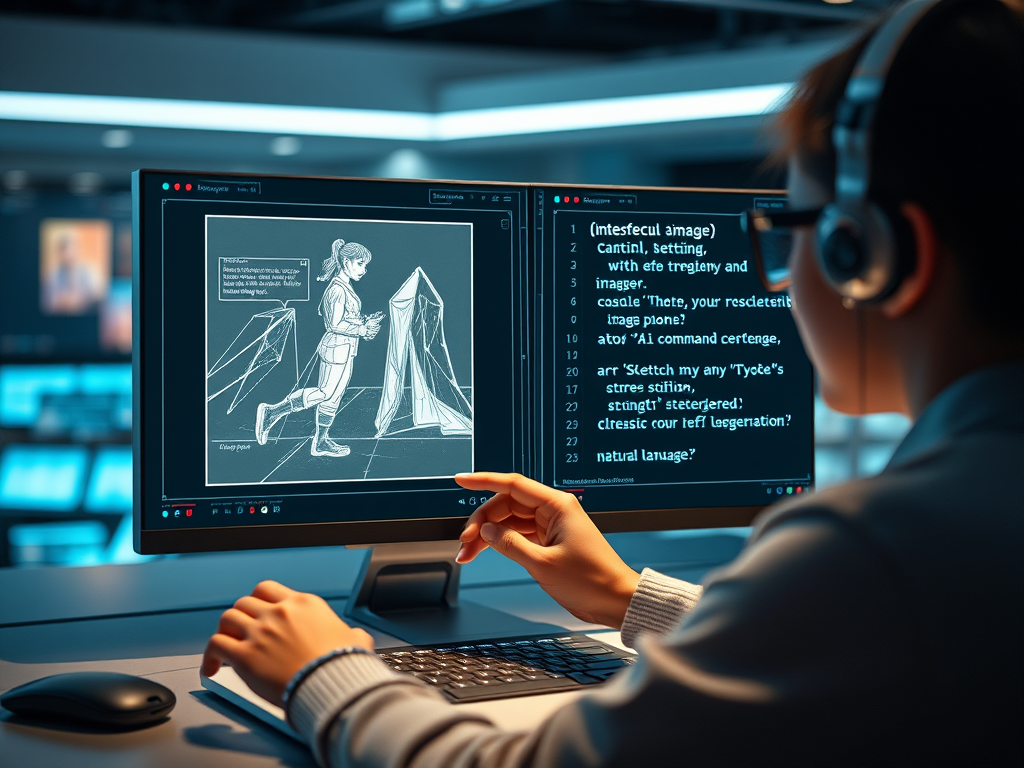
The field of artificial intelligence (AI) continues to reshape how we interact with digital media, and a recent breakthrough from MIT’s Computer Science and Artificial Intelligence Laboratory (CSAIL) is pushing the boundaries of image generation and editing to new heights. As highlighted in the MIT News article, “A New Way to Edit or Generate Images” (published July 21, 2025), researchers have developed a novel technique that enables precise, intuitive image manipulation using natural language instructions. This advancement, rooted in enhanced diffusion models, promises to transform industries ranging from graphic design to entertainment, and potentially beyond. In this blog post, we’ll explore the significance of this innovation, dive into its technical underpinnings, evaluate its strengths and limitations, and consider its broader implications—all inspired by a review of the original article.
A Leap Forward in Image Manipulation
The MIT News article introduces a groundbreaking system that allows users to generate or edit images with remarkable precision by simply describing their desired changes in natural language. For example, a user might say, “Change the dog’s fur to blue” or “Turn this sketch into a photorealistic landscape,” and the system delivers results that align closely with the instruction. This capability builds on the foundation of diffusion models, a class of generative AI techniques that have gained prominence for their ability to produce high-quality images. Unlike previous methods, which often required complex prompts or manual intervention, MIT’s approach streamlines the process, making it accessible to both professionals and novices.The article emphasizes the system’s practical applications, particularly in creative industries. Graphic designers, for instance, can iterate on designs without needing advanced technical skills, while content creators can generate visuals for films, games, or marketing campaigns with minimal effort. The inclusion of sample images in the article—showcasing transformations like a sketch evolving into a vivid scene or a dog’s appearance being altered—vividly illustrates the technology’s potential. This balance of accessibility and power is what makes the research stand out, as it democratizes advanced image manipulation while maintaining high fidelity.
Technical Foundations: Unpacking the Diffusion Model
To fully appreciate MIT’s breakthrough, it’s worth delving into the technical details, which the article touches on but doesn’t fully explore. Diffusion models, the backbone of this system, are a type of generative AI that iteratively refines random noise into coherent images. They operate by simulating a “denoising” process, where a model learns to reverse a gradual corruption of an image, transforming noise into a structured output. Mathematically, this involves training a neural network to approximate the conditional probability distribution of image data, guided by a loss function that minimizes the difference between predicted and actual pixel values.MIT’s innovation lies in enhancing the controllability of diffusion models. Traditional diffusion models, like those used in DALL·E 2 or Stable Diffusion, rely on text embeddings from models like CLIP (Contrastive Language–Image Pretraining) to guide image generation. However, these systems often struggle with fine-grained control, especially when users want to edit specific parts of an image without affecting others. The MIT team addresses this by introducing a novel architecture that integrates localized control mechanisms. While the article doesn’t specify the exact approach, it’s likely that the system employs a combination of attention mechanisms and region-specific conditioning.Attention mechanisms, widely used in transformers, allow the model to focus on specific parts of an image when processing a user’s instruction. For example, when tasked with “changing the dog’s fur to blue,” the model identifies the dog’s fur region using spatial attention maps and applies the color change only to that area. Region-specific conditioning further enhances this by anchoring edits to particular image segments, ensuring that unrelated areas (e.g., the background or the dog’s eyes) remain unaffected. This is a significant improvement over earlier models, which might inadvertently alter the entire image or produce inconsistent results.Another key advancement is the system’s ability to handle natural language inputs with greater nuance. The article mentions that users can provide “intuitive” instructions, suggesting that the model leverages advanced natural language processing (NLP) techniques to parse and interpret complex prompts. This likely involves fine-tuning a language model to map textual descriptions to specific image features, possibly using a dataset of paired text-image edits. The result is a system that understands context and intent better than its predecessors, reducing the need for users to craft overly precise or technical prompts.
Strengths: Why This Matters
The MIT News article does an excellent job of highlighting the system’s strengths, which are worth expanding upon:
- Accessibility for All: By allowing users to interact with the system via natural language, MIT’s technology lowers the barrier to entry for image manipulation. Designers, artists, and even hobbyists can achieve professional-grade results without needing to master tools like Photoshop or understand the intricacies of AI models. This democratization aligns with broader trends in AI, where user-friendly interfaces are making advanced technologies more inclusive.
- Precision and Flexibility: The ability to edit specific image regions with high accuracy is a game-changer. Previous generative models often struggled with localized edits, leading to artifacts or unintended changes. MIT’s system, with its focus on region-specific control, ensures that modifications are both precise and contextually appropriate, as demonstrated by the article’s examples (e.g., altering a dog’s fur color without changing its surroundings).
- Real-World Applications: The article emphasizes creative applications, such as graphic design and content creation, but the technology’s potential extends further. In fields like medical imaging, the system could assist in generating or editing diagnostic images based on textual descriptions of abnormalities. In autonomous driving, it could help simulate diverse scenarios for training perception systems. These possibilities, though not deeply explored in the article, underscore the system’s versatility.
- Visual Engagement: The article’s inclusion of sample images is a strength that cannot be overstated. Visual examples make the technology’s capabilities tangible, helping readers grasp the leap from abstract concepts to practical outcomes. For instance, seeing a rough sketch transformed into a photorealistic landscape illustrates the model’s ability to bridge creativity and realism.
Limitations and Areas for Improvement
While the article is enthusiastic about the technology, it glosses over potential limitations, which are critical to understanding the system’s current state and future potential:
- Technical Depth in Reporting: The MIT News piece prioritizes accessibility over technical detail, which is understandable but leaves gaps for those seeking a deeper understanding. For example, it doesn’t specify the computational requirements of the model, such as whether it can run on consumer-grade hardware or requires specialized GPUs. Given the resource-intensive nature of diffusion models, this is a relevant concern for practical deployment.
- Ethical Considerations: The article briefly mentions potential misuse, such as generating misleading images, but doesn’t delve into the ethical implications. Advanced image manipulation tools raise concerns about deepfakes, copyright infringement, and the erosion of trust in visual media. The MIT team likely incorporates safeguards, such as watermarking or detection mechanisms, but these are not discussed, leaving readers without a sense of how the technology addresses these risks.
- Scalability and Generalization: The article focuses on creative applications but doesn’t address whether the system performs equally well across diverse domains, such as scientific imaging or cultural heritage preservation. Additionally, the model’s ability to handle edge cases—such as ambiguous instructions or low-quality input images—remains unclear. These are critical for real-world adoption and warrant further exploration.
- Training Data Transparency: Diffusion models rely on vast datasets, often scraped from the internet, which can introduce biases or ethical concerns (e.g., using copyrighted images without permission). The article doesn’t mention the dataset used, which is a missed opportunity to address transparency and fairness in AI development.
Broader Implications and Future Directions
MIT’s breakthrough is more than a technical achievement; it’s a glimpse into the future of human-AI collaboration. By enabling intuitive image manipulation, the system empowers users to focus on creativity rather than technical execution. This aligns with the broader mission of AI to augment human capabilities, as seen in tools like GitHub Copilot for coding or AI-driven writing assistants.Looking ahead, the technology could evolve in several directions. Integration with augmented reality (AR) or virtual reality (VR) platforms could enable real-time, immersive image editing, revolutionizing gaming and virtual design. In education, it could facilitate interactive learning tools, allowing students to visualize concepts through dynamic image generation. In healthcare, precise image manipulation could aid in surgical planning or diagnostic visualization, provided the system is rigorously validated for accuracy.However, the path forward must address ethical challenges. The potential for misuse—such as creating hyper-realistic deepfakes—requires robust countermeasures, such as embedding digital signatures in generated images or developing detection algorithms. Collaboration with policymakers and industry stakeholders will be crucial to establish guidelines for responsible use.
Conclusion
MIT’s new approach to image editing and generation, as detailed in the July 21, 2025, MIT News article, represents a significant advancement in generative AI. By combining enhanced diffusion models with natural language processing and region-specific control, the system offers unprecedented precision and accessibility. Its potential to transform creative industries is clear, and its applications may extend to fields like medicine, autonomous systems, and education.The article itself is a compelling introduction, balancing accessibility with excitement about the technology’s possibilities. However, it could benefit from deeper technical insights and a discussion of ethical considerations to provide a more holistic view. As AI continues to evolve, innovations like MIT’s will shape how we create, interact with, and trust visual media. For now, this breakthrough is a testament to the power of combining human creativity with AI’s computational prowess—a partnership that promises to redefine the boundaries of what’s possible.
Sources:
- MIT News, “A New Way to Edit or Generate Images,” July 21, 2025. Available at: https://news.mit.edu/2025/new-way-edit-or-generate-images-0721
Note: For those interested in exploring the technical details further, the original research paper (likely available through CSAIL’s publications) would provide a deeper dive into the model’s architecture and training process.
Leave a Reply